Results
The Global Evoked Naming Task (GENTask) has been used since 2015 in over 150 patients. Semantic, phonological, syntactic, and articulatory errors are detected quickly as the task simultaneously examines these different pathways. It revealed to be more sensitive than Object Naming alone, fulfilling the primary aim of detecting the presence of language pathways as early as possible, before any lesioning.
No particular disadvantages were noted compared to the Object Naming task, except for some increased fatigability, as the GENTask requires more attention and effort from the patient. Therefore, the task should be extensively evaluated in the preoperative period and tailored to the patient’s abilities.
Unlike sequentially alternating specific tasks, which risk masking the evaluation of one pathway while assessing others, the high sensitivity of the GENTask avoids these blind moments. Alternating the GENTask during stimulation with Spontaneous Speech outside stimulation periods for global evaluation, while providing some relaxation for the patient, is recommended.
Future Perspectives
Our aim is to create a platform where ideas about multimodal tasks can be presented. Suggestions to enhance the reliability and ergonomics of the tasks are welcome. Other tasks can be integrated, provided they are multimodal and fit within the 5-second presentation frame necessary to maintain the flow and fluidity of the mapping.
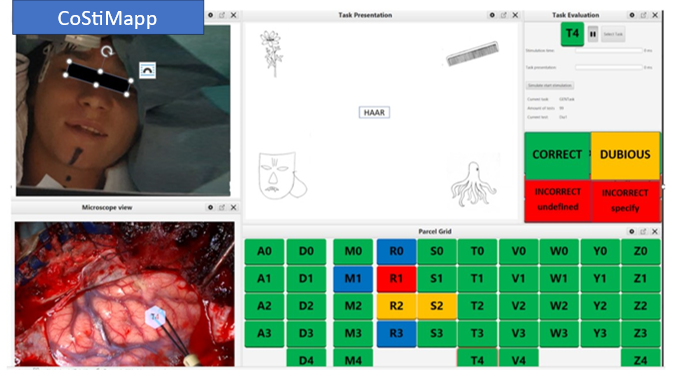
Another perspective is to incorporate the GENTasks within a cognitive mapping module, Co(rticosubcortical) Sti(mulation) Mapp(ing) App(lication), where all relevant data concerning awake mapping procedures is integrated. This includes control of the patient’s face, visualization of the operative field from micro- or exoscope with navigation HUD, the presented tasks and their selection, and evaluation with an Excel-like registration module.