GENTasks subdivision
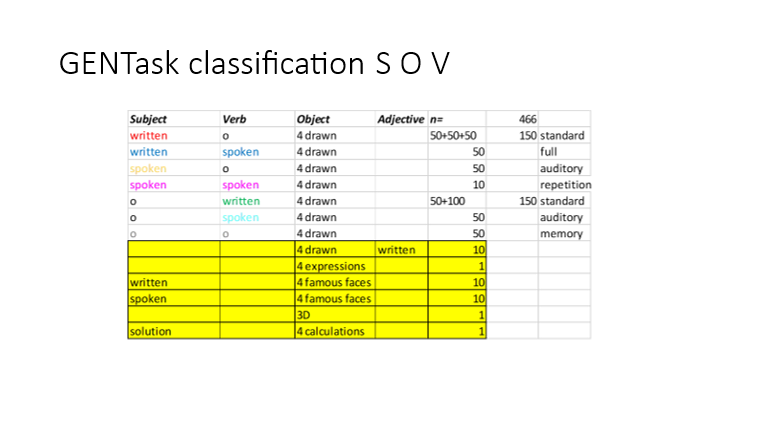
Objects, subjects, or verbs can be presented either as drawings in the four corners, written in the center, spoken, or a combination of these. Theoretically, 18 combinations are possible, from which we have selected the most relevant:
EXAMPLES SUBJECTS/OBJECTS
Subjects
Persons: patient him- or herself, family members, famous persons, etc.
Animals or other living objects
Objects
Home, garden, street, transport, town, countryside, farm, seaside, forest, school, hospital, shop, park, zoo
Food, feast, clothing, job, toys, health, doctor
Body, people, family, countries
Days, time, seasons, weather
Animals, trees, sport
Colors, shapes, numbers
Antonyms
Verbs
Transitive (requires an object)
Intransitive (may require a preposition)
The Global Evoked Naming Task has been partially normated and validated in Dutch, based on the DuLIP tasks (Dutch Language Intraoperative Protocol).
Selection of GENTasks per (sub)cortical area
Considering the fascicle terminations in each parcel, the GENTasks can be adapted to the area to be resected; hence the idea to use tasks most relevant for the underlying language fascicles. Since syntactic functions are particularly confined to the frontal lobe, resections of frontal lesions should be monitored with verb generation/action naming and sentence production.
The GENTask with four drawn objects and one written subject requires the production of a sentence with a (transitive) verb, connecting the subject and object. On the other hand, parieto-temporal lesion resections are better monitored with auditory input, provided by the "speaking slide," where the (intransitive) verb is presented audibly at the start of the task trigger.
Schematically, a functional-to-anatomical relationship can be proposed:
Verb Generation (Syntax): (superior) frontal parcels
Auditory, spoken verb & repetition (Phonological tasks): superior-temporal & parietal parcels
Correlation (Semantics): mid- & inferior temporal parcels
Memory: anterior temporal parcels
Or an anatomical-to-functional relation:
Frontal: Syntax > Phonology > Semantics
Parietal: Phonology >> Semantics
Temporal: Semantics > Phonology
Proposed Scheme:
Frontal: 4 Objects, 1 Subject (written or spoken), Verb to generate
Parieto-Temporal: 4 Objects, 1 Subject (written), 1 Verb (spoken)
Temporal: 4 Objects, 1 Verb (written or spoken)
The purpose is to obtain from the patient the construction of a short, grammatically and semantically correct sentence. The written and depicted items must be linked with a verb, proposed or generated by the patient. Besides pictures of objects, living or not, famous faces, numbers, colors, or geometrical shapes can also be presented.
Instead of verbs, sounds of living (e.g., animals) or daily life objects (natural phenomena) are available. The verbs are preferably transitive to allow a direct object or intransitive, lowering syntactic complexity. Simultaneous evaluation of the visual fields is achieved by presenting the four objects in the four corners of the screen: the correct item is best projected in the corner opposite to the lesion (left corner for right-sided lesions and vice-versa, superior corner for inferior lesions and vice-versa).
Manual indication of the correct response on the touch screen by the patient, using the index finger opposite to the lesional side, offers the simultaneous possibility to evaluate mobility.
Another advantage is the possibility to evaluate illiterate or non-native patients through visual presentation of the four objects with auditory input of a subject or verb. An interpreter is necessary to evaluate the response accurately.
In case of error, spontaneous speech is elicited to verify if a steady state is reached before restarting the mapping tasks.
Visual fields
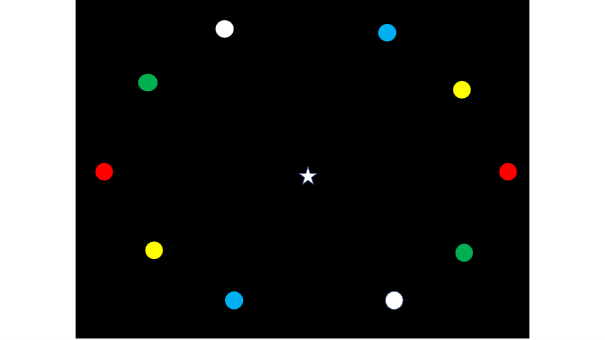
Strict evaluation of the visual fields is obtained by proposing colored dots on a black background. Ten colored dots are available, five colors on each side, diametrically opposed. From these , 2 dots are displayed, one on each side , making it easy to diagnose visual extinction.
For further details, refer to the manuscript “Intraoperative Mapping of Cognitive Networks, E. Mandonnet & G. Herbet, Chap. 2 Vision, p. 31-33.”
This task can be alternated with the GENTask, as the rationale of color recognition at the periphery matches the presentation of four pictures in the corners of the screen.